
Course
Driver Induction Training Programme - Hindi
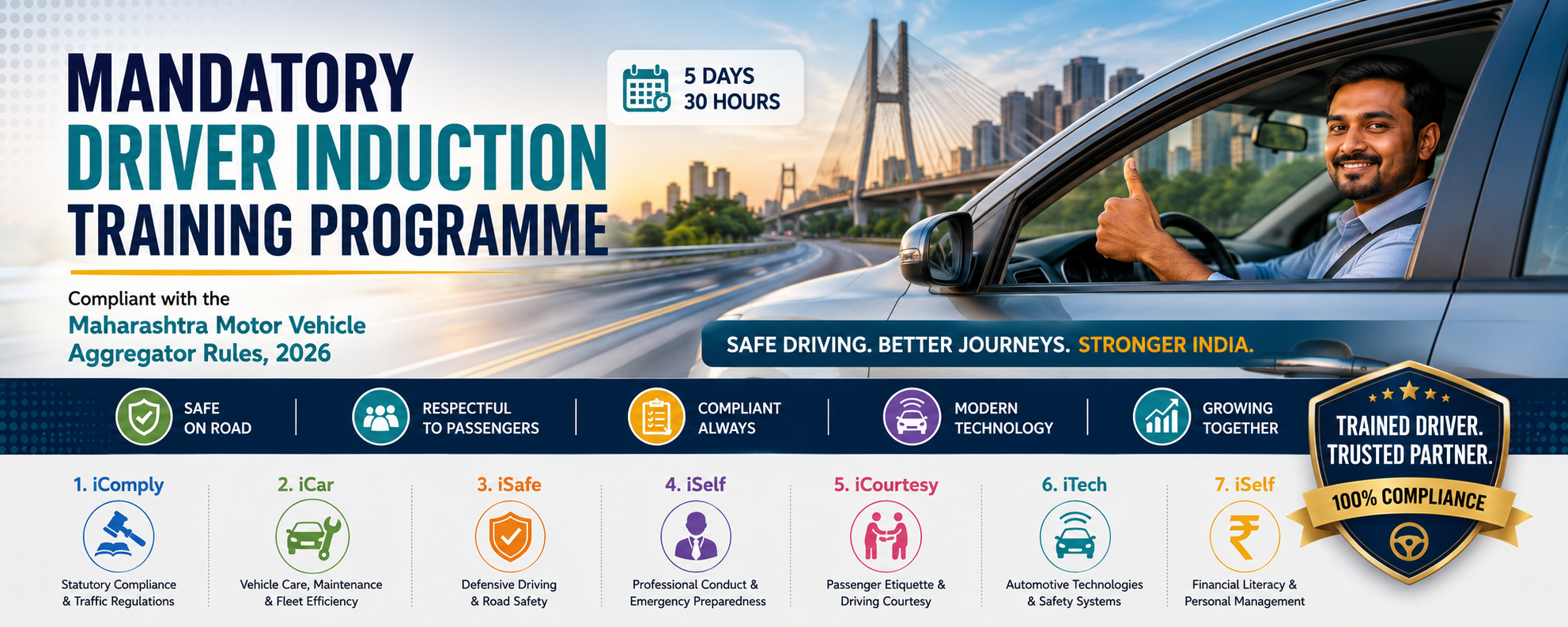
Compliant with the Maharashtra Motor Vehicle Aggregator Rules, 2026
Ready to start?
New learners can create an account from the login screen. You will return here to complete enrollment.
This comprehensive 5-day (30-hour) induction training programme equips cab aggregator drivers, chauffeurs, and fleet operators with the essential knowledge, practical skills, and professional conduct required under the Maharashtra Motor Vehicle Aggregator Rules, 2026. Designed to help platform operators maintain full regulatory compliance with the Maharashtra Transport Department, the curriculum delivers robust instruction spanning statutory traffic laws, vehicle care and safety, advanced vehicle technologies, defensive driving techniques, professional etiquette, passenger care, and basic financial literacy.
Course outline
-
Chapter 1: Statutory Compliance & Traffic Regulations (iComply)
This chapter grounds drivers in the legal requirements and traffic regulations governing commercial road operations in India. Participants will gain a thorough understanding of the Motor Vehicles Act, essential vehicular documentation, permissible speed limits, parking regulations, and mandatory vehicle specs like number plate standards and glass tinting. The module also details common traffic offences, modes of being challaned, and the practical application of road signs, markings, traffic lights, and police signals to ensure 100% legal compliance on every trip.
- 1.0 Welcome to Driver Induction Training Programme
- 1.1 Car Insurance - iCompliance
- 1.2 Common Traffic Offences - iCompliance
- 1.3 Drive within Speed Limit iCompliance
- 1.4 Essential Documents - iCompliance
- 1.5 Modes of being Challaned - iCompliance
- 1.6 Motor Vehicles Act 1988 - iCompliance
- 1.7 No Parking Zones - iCompliance
- 1.8 Number Plate and Tinted Glass Conformance Specs - iCompliance
- 1.9 Renewal of License - iCompliance
- 1.10 Understand & Follow Road Markings - iCompliance
- 1.11 Understand & Follow Traffic Light Signals - iCompliance
- 1.12 Understand & Follow Traffic Policeman’s Signals - iCompliance
- 1.13 Stay Safe with Road Signs - iCompliance
-
Chapter 2: Vehicle Care, Maintenance & Fleet Efficiency (iCar)
Designed to maximize vehicle longevity and passenger safety, this chapter provides practical training on essential vehicle upkeep and pre-trip inspections. Drivers will learn daily safety checks, routine monitoring of tyre pressure, wear, and tread, along with proper battery, coolant, and lubricant management. The curriculum covers hands-on procedures for fixing punctures and changing tyres, as well as detailing, interior sanitisation, pollution checks, and fuel-efficiency practices tailored to various engine and fuel types.
- 2.1 Check Your Car Periodically - iCar
- 2.2 Daily Safety Checks - iCar
- 2.3 Checking Tyre Pressure - iCar
- 2.4 Battery Care - iCar
- 2.5 Coolant Check - iCar
- 2.6 Window Washer Fluid Check - iCar
- 2.7 Various Types of Fuel - iCar
- 2.8 Tyre Wear - iCar
- 2.9 Tyre Changing - iCar
- 2.10 Wheel Balancing - iCar
- 2.11 Fix a Tyre Puncture - iCar
- 2.12 Pollution Check - iCar
- 2.13 Use of Lubricants - iCar
- 2.14 Cleaning the Car Inside Out - iCar
- 2.15 Steam Cleaning the Car - iCar
- 2.16 Tyre Spray - iCar
- 2.17 Scratch Remover - iCar
- 2.18 Windshield Treatment - iCar
- 2.19 Using a Navigation System - iCar
-
Chapter 3: Defensive Driving & Road Safety (iSafe)
Focusing on risk mitigation and accident prevention, this chapter delivers comprehensive instruction on defensive driving across diverse road and weather conditions. Drivers will master lane discipline, roundabouts, overtaking, night driving, and navigating adverse weather such as rain and fog. Advanced units cover hazard management around vulnerable road users (pedestrians, cyclists, motorcyclists, and heavy vehicles), emergency maneuvers like handling tyre bursts and gentle crashing, avoiding tailgating and distractions, and managing physical factors like fatigue and vision.
- 3.1 Safe Driving is Defensive Driving - iSafe
- 3.2 Defensive Driving Around Buses - iSafe
- 3.3 Defensive Driving Around Cyclists - iSafe
- 3.4 Defensive Driving Around Motorcyclists - iSafe
- 3.5 Defensive Driving Around Pedestrians - iSafe
- 3.6 Defensive Driving Around Trucks - iSafe
- 3.7 Lane Driving - iSafe
- 3.8 Negotiating a Roundabout - iSafe
- 3.9 Merging Smoothly into Traffic - iSafe
- 3.10 Priority at Unmarked Intersections - iSafe
- 3.11 Zebra Crossings - iSafe
- 3.12 U Turn - iSafe
- 3.13 Overtake Safely - iSafe
- 3.14 Driving in Rain - iSafe
- 3.16 Night Driving - iSafe
- 3.17 Driving on Unmetalled Roads - iCourtesy
- 3.18 Importance of Seat Belt - iSafe
- 3.19 Use and Understand Driver's Signals - iSafe
- 3.20 Stay Safe with Headlights - iSafe
- 3.21 Stay Safe with Hazard Lights - iSafe
- 3.22 Stay Safe At Petrol Pumps - iSafe
- 3.23 Driving for a Baby's Safety & Comfort - iSafe
- 3.24 Avoid Tailgating - iSafe
- 3.25 Distractions in the Car - iSafe
- 3.26 Driving and Vision - iSafe
- 3.27 Driving Fatigue - iSafe
- 3.28 Driving - Hearing Vertigo and Seizures - iSafe
- 3.29 Don't Drink & Drive - iSafe
- 3.30 Park Safely - iSafe
- 3.31 Safely Move Off From Behind a Parked Vehicle - iSafe
- 3.32 Steering Techniques - iSafe
- 3.33 How to Crash Gently - iSafe
- 3.15 Drive Safely in the Fog - iSafe
- 3.34 Handling a Tyre Burst - iSafe
-
Chapter 4: Professional Conduct & Emergency Preparedness (iSelf)
This chapter prepares drivers to operate with high integrity, professional demeanor, and operational readiness as commercial chauffeurs. It covers personal grooming, dress code, punctuality, and confidentiality alongside city, highway, and heavy-traffic driving strategies. Crucially, the module equips drivers to handle high-stress situations gracefully—including road rage, customer management, and lonely stretches—while providing actionable protocols for emergency response, accident site management, and life-saving first-aid techniques.
- 4.1 Dress for the Drive - iSelf
- 4.2 Integrity on Duty - iSelf
- 4.3 Habits to Kill - iSelf
- 4.4 Maintaining Confidentiality - iSelf
- 4.5 Punctuality & Taking Leave - iSelf
- 4.6 Driving for Comfort and Health - iSelf
- 4.7 Timing the Drive - iSelf
- 4.8 City Driving - iSelf
- 4.9 Conservation Oriented Driving - iSelf
- 4.10 Managing your Passengers - iSelf
- 4.11 Driving Etiquette (Honking) - iSelf
- 4.12 Driving Manners Flashing Lights - iSelf
- 4.13 Etiquette at Toll Plaza - iSelf
- 4.14 Parallel Parking - iSelf
- 4.15 Handling Road Rage - iSelf
- 4.16 Driving on Lonely Stretches - iSelf
- 4.17 Driving in Heavy Traffic - iSelf
- 4.18 Highway Driving - iSelf
- 4.19 Pollution - Health Risk - iSelf
- 4.20 Be Prepared for an Accident - iSelf
- 4.21 Response at an Accident Spot - iSelf
- 4.22 Reacting to an Emergency - iSelf
- 4.23 First Aid - iSelf
-
Chapter 5: Passenger Etiquette & Driving Courtesy (iCourtesy)
Centred on passenger satisfaction, dignity, and gender-sensitisation, this chapter trains drivers in providing a courteous, comfortable, and respectful ride experience. Topics include smooth braking and acceleration, professional greeting habits, door assistance, mobile and audio etiquette, and careful pickup/drop-off practices. Special emphasis is placed on consideration for vulnerable passengers, including senior citizens, individuals with disabilities, children, and special-needs riders.
- 5.1 Prepare for the Drive - iCourtesy
- 5.2 Driving Etiquette (Loud Music) - iCourtesy
- 5.3 Mobile Manners - iCourtesy
- 5.4 Open Car Doors for Passengers - iCourtesy
- 5.5 Passengers Who Need Special Care - iCourtesy
- 5.6 Braking Gently - iCourtesy
- 5.7 Common Courtesy to Fellow Drivers - iCourtesy
- 5.8 Dropping Off and Picking Passengers - iCourtesy
- 5.9 Parking Manners - iCourtesy
- 5.10 Show Consideration to Special Pedestrians - iCourtesy
-
Chapter 6: Automotive Technologies & Safety Systems (iTech)
This technical module introduces drivers to modern vehicle systems and active/passive safety features present in contemporary commercial fleets. Participants will learn the functionality and operational advantages of systems such as ABS, EBD, Electronic Stability Control (ESC), SRS airbags, seatbelt pre-tensioners, and crash sensors. Additionally, the chapter covers automatic transmissions, cruise control, hill descent control, drowsiness detection (Attention Assist), parking sensors, and advanced tyre management technologies like Run-Flats and nitrogen filling.
- 6.1 Anti-Lock Brake System (ABS) - iTech
- 6.2 Four Wheel Drive and All Wheel Drive (Vehicle Technology) - iCar
- 6.3 Engine Power and Capacity (Vehicle Technology) - (iTech)
- 6.4 Multi-Cylinder Engine - iCar
- 6.5 Automatic Transmission - iCar
- 6.6 Overheating of Engine - iCar
- 6.7 Electronic Brake-Force Distribution - iCar
- 6.8 Electronic Stability Control - iCar
- 6.9 Crash Sensors - iCar
- 6.10 Cruise Control - iCar
- 6.11 Hill Descent Control - iCar
- 6.12 Multifunctional Steering Wheel - iCar
- 6.13 SRS Airbags - iCar
- 6.14 Seat Belt Pre-tensioner - iCar
- 6.15 Night View Assist (Vehicle Technology) - iCar
- 6.16 Attention Assist-Detecting Drowsy Drivers-iCar
- 6.17 Parking Safety Features - iCar
- 6.18 Filling Nitrogen in Car Tyres - iCar
- 6.19 Run Flat Tyres - iCar
- 6.20 Anti-theft Systems - iCar
- 6.21 Adaptive Headlights - iCar
-
Chapter 7: Financial Literacy & Personal Management (iSelf)
To support the overall well-being and financial stability of commercial drivers, this chapter provides a practical introduction to personal finance and banking services. Drivers will learn how to open and manage bank accounts, utilize formal banking services, navigate creditworthiness, and understand basic tax responsibilities and insurance coverages. The module also educates drivers on identifying and avoiding fraudulent financial practices and Ponzi schemes to secure their personal earnings.